written by Tom Frank
What is Arsenic?
Arsenic is a naturally occurring element found in rock and soil, which can also seep into the water supply from use in certain industries or agriculture. Arsenic can be combined with other elements to form chemicals used to preserve wood and to kill insects on cotton and other agricultural crops.
Types of Arsenic
Arsenic, “As”, usually exists in two forms, or valences, Arsenic (III) and Arsenic (V)
Arsenic (V) can be found in water supplies with higher dissolved oxygen content and in shallow wells. Arsenic (III) is usually found in deeper wells, with a lower dissolved oxygen content.
Arsenic(III) has a neutral charge, and Arsenic(V) has a negative charge.
When treating Arsenic in household water, it is important to identify the type of Arsenic in your water supply. Local water testing labs can perform an Arsenic speciation test; this will tell you how much of the Arsenic is in the (III) or (V) form. The test results will help you choose the proper Arsenic filtration/removal/reduction system for your home.
Treating Arsenic
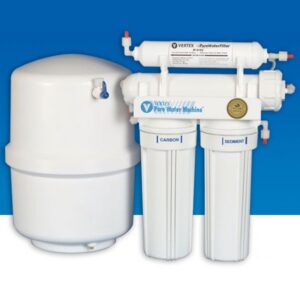
- Reverse osmosis for point of use removal works very well on Arsenic (V), but is not effective on Arsenic (III)
- Anion exchange units will work well on Arsenic (V), but will not remove Arsenic (III)
- Anion Hybrid Resins work well on Arsenic (V) and will remove a high amount of Arsenic (III) due to the fact that the resin has been impregnated with Iron Oxide, which attracts the neutrally charged Arsenic (III)
- Granular Ferric Oxide Media works well on both species of arsenic using Adsorption, and the ferric oxide also attracts the Arsenic (III)
- Titanium-Based Media is also a choice for both forms of Arsenic and uses adsorption to reduce Arsenic.
Remember: All the above methods and products have restrictions depending on what else is in your water supply, the amount of Arsenic (III) and Arsenic (V), and the pH of your water.
Have your water tested; if it contains arsenic, work with a local water treatment professional to help assure your water is properly treated.